Is Spain Good?
This seems obvious, right?

This seems like quite an easy question to answer. Spain has made it to the Round of 16 undefeated without conceding a single goal. They have world class players like Lamine Yamal, Pedri, Cubarsi, and Ballon d’Or winner Rodri. They won the Euros two years ago. Of course they’re good.
Right?
If so, then what makes them good?
Spain, unsurprisingly, has the highest average possession in the tournament up through the round of 32 with 68.2% across the four games they have played. So does this make them good? Perhaps at controlling the game, but high possession doesn’t ensure positive results. Just look at Türkiye, who has had the second highest possession this World Cup, but whose only points came from beating the United States’s second team after both teams had already confirmed their standings.
High possession helps not just with creating chances, but with defending, which data shows Spain is very good at. Not only are they tied with Mexico for the fewest goals conceded, having not given up a single goal, but they also have conceded the least xG through the round of 32 by a large margin, with only 0.96 against, according to futi.live. The next best team in this regard is Mexico, but they’ve conceded more than twice of Spain, with an xGA of 2.41. Additionally, Spain have conceded just 0.15 xG from transitions. For a team that keeps the ball as much as Spain does, this is vital. It’s hard enough for the opposition to keep the ball long enough to build a good attack, so taking away any threat from counter attacks makes it nearly impossible to get scored on.
So is Spain good? At keeping the ball, yes. At defending, also yes. But what about attacking?
Simply looking at their xG, the answer appears to be yes as well. They have 1.88 xG per 90 minutes, 6th highest in the tournament. But xG doesn’t tell the full story. Türkiye isn’t far behind Spain in xG/90 and look where that got them.
Rather, I want to focus on how Spain are generating their chances, and diving into Futi’s detailed xG data is a good place to start.
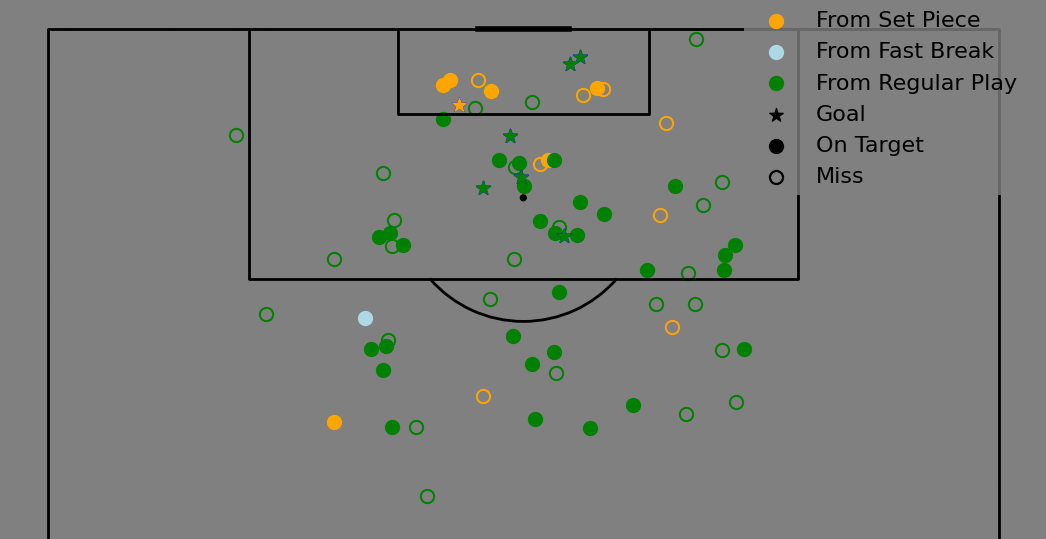
First, let’s look at Spain’s goals and where their shots have come from. Spain has taken 78 shots so far in the World Cup, 4th most in the tournament. Of these, 29 (37%) have from outside the box, many of which were speculative at best. 61 of Spain’s shots (78%) were assisted with a pass from a teammate: 6 from crosses, 3 from chipped passes, 8 from set pieces, and the remaining 44 shots from a variety of passes.
But what about their goals? The first one, against Saudi Arabia, came from winning the ball at half field from a Saudi goal kick. The ball was played in behind the defense, then Oyarzabal put in a low cross to Lamine Yamal at the back post. The second goal of that game came from a corner. The third was the result of a cross to the far post that was put back across goal then headed down to Oyarzabal, and the fourth was from another corner. The goal against Uruguay came from a low cross into a not-very-compact block followed by an error by the keeper. The first goal against Austria came from Pedri playing the ball wide to Cucurella who crossed it back in, taking advantage of the space Austria’s midfielders left when they stepped to Pedri. The second came from a poor shot attempt from about 25 yards out that deflected into the box, then the ball was chipped to Porro’s head. And the third came from Cucurella putting the ball behind Austra’s mid block from out wide to Oyarzabal. Of their 8 goals, 2 have been from corners, 5 from crosses, and one from the ball being played from out wide into the box behind the defense.
According to Futi, Spain has accumulated 3.94 xG from stable possession, 8th most so far in this World Cup. This looks good, but with the players they have and the amount of possession they’ve had, being this high in the rankings is certainly expected. What is less expected however, is the share of total xG they’ve accumulated through possession. Shots in these phases only account for 46% of Spain’s xG. So is Spain just good at transitions and set pieces, or are they less efficient at attacking through possession?
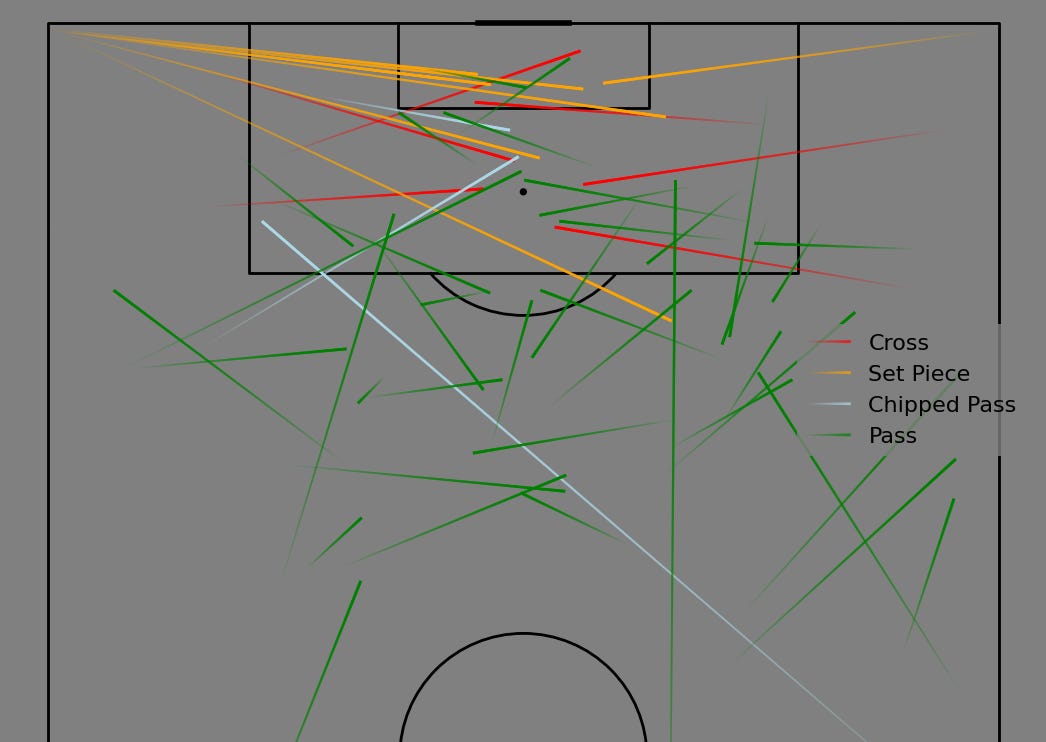
To see how they create shots, we can look at their successful open play passes into the zone right in front of the goal. Half of these passes are either crosses or chipped balls, and of the other half, only one really gets close to the 6-yard box. The rest end around the penalty spot or further back. Additionally, it shows that the majority of their passes into this area come from wider areas.
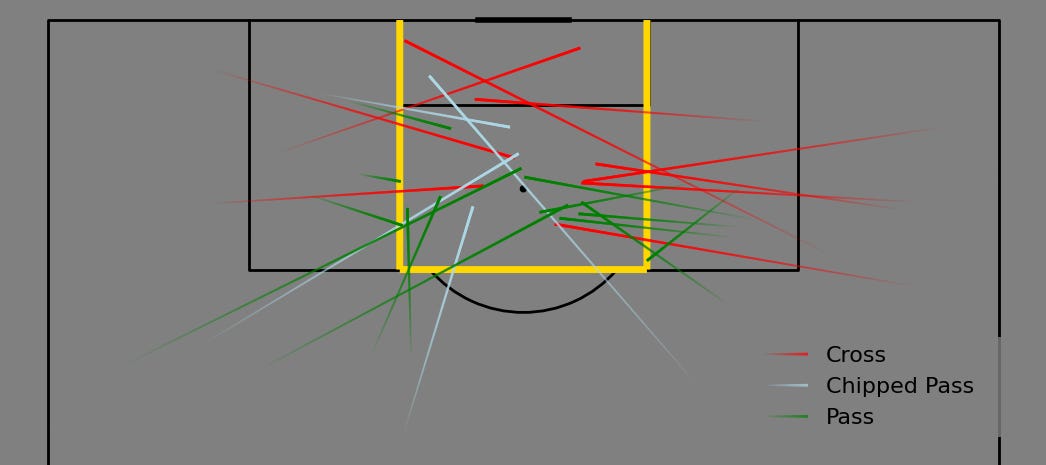
In total, Spain has crossed the ball 70 times from open play. That is the fourth most in the tournament. However, their cross success is only 21%, 22nd highest in the World Cup. And only 6 of those have assisted a shot.
Crossing is not necessarily bad. There are certainly situations where it’s a good option (just look at any of Spain’s goals) and there are teams that can make really good use of crosses. But Spain? The team known for being able to pass through their opposition? With incredibly technical players who can easily escape almost any pressure?
Crossing so often feels like a plan B, or even C, especially with such technical teams, something to do once you’ve tried to break down the opposition’s low block. But with Spain this tournament, it hasn’t really seemed like there’s been a plan A for breaking down low blocks. Against Cabo Verde, it seemed like their entire game plan was cross or shoot from 30 yards out. No attempts to play through or manipulate the block centrally.
They did try to play centrally a few times against Austria at least. Their first goal that game came from Pedri dribbling centrally, which caused Austria’s center mids to step up, which created space between the midfield and defense that Oyarzabal was able to take advantage of to score. And their second followed a pass into the middle to Olmo, but he had no options centrally so he tried a poor shot, so after a favorable deflection and good tackle by Cucurella, Baena was able to cross the ball in. But their chance creation attempts still largely relied on crosses.
Other than lumping the ball into the box and hoping someone gets their head on it, how does Spain try to create chances? One approach they’ve had some success with is with a cross to a back post runner (usually Cucurella) who puts it back across goal. This is how they scored their 3rd goal against Saudi Arabia. They also created their best chance against Cabo Verde this way, but Ferran Torres ended up hitting the crossbar.
Other than that, they’ve used transitions and set pieces. According to Futi, Spain has the 6th most xG from transitions with 2.75, which accounts for 32% of their total xG. One of the reasons this is so high is because their transitions happen high up the pitch, which makes it more likely for them to generate a shot. Spain has had 62 successful ball-winning actions in the attacking third, more than any other team in the tournament. When they lose the ball, they counterpress. And when they win it back, they can create chances when the defense is less organized.
The other 21% of their xG comes from set pieces, which, for a team that focuses so heavily on possession, may be unexpected. They have accumulated 1.8 xG, mostly, if not all, from corners, and this has resulted in two goals, although one didn’t contribute to the xG because it was an own goal.
So combined, this leaves Spain’s ideas to score as what, cross and inshallah? Counterpressing? Corners? A single other play that they’ve seen moderate success with? What happens when they face a team that can defend crosses? We’ve seen it once against Cabo Verde and although they had a few good chances, they defaulted to playing the ball wide and sending in hopeless crosses. And what about when they come up against Portugal, who have Vitinha and João Neves, some of the best midfielders in the world who are excellent at escaping pressure? Will they be able to create enough chances from pressing?
They have the players to create chances from possession without having to rely on crosses. Lamine Yamal, Pedri, Dani Olmo. All really good players who can combine centrally and have proven with Barcelona that they can play through blocks. Cubarsi can play great line breaking passes from defense. But will they even try to break down low blocks, or will they immediately resort to crosses again?
So is Spain good? The answer, pretty objectively, is yes. They are very good. Their rest defense? Excellent. Their ability to control the game? Excellent. But their ability to create chances from possession? Might be, but if so, they haven’t really shown it.